Laws of Family Purity According to Sephardic Customs Torat Hatahara - R. David Yossef
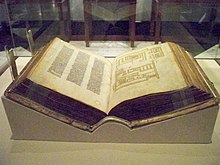
Mishneh Torah, a code of Jewish law by Maimonides, a Sephardic Jew
Sephardic law and community are the practice of Judaism by the Sephardim, the descendants of the historic Jewish customs of the Iberian Peninsula. Some definitions of "Sephardic" inaccurately include Mizrahi Jews, many of whom follow the same traditions of worship only have different ethno-cultural traditions. Sephardi Rite is not a denomination or move similar Orthodox, Reform, and other Ashkenazi Rite worship traditions. Sephardim thus comprise a customs with distinct cultural, juridical and philosophical traditions.[1]
Sephardim are, primarily, the descendants of Jews from the Iberian peninsula. They may be divided into the families that left in the Expulsion of 1492 and those that remained in Spain every bit crypto-Jews, fleeing in the following few centuries. In religious parlance, and by many in modern State of israel, the term is incorrectly used in a broader sense to include all Jews of Ottoman or other Asian or North African backgrounds, whether or non they have whatever historic link to Spain, though some adopt to distinguish between Sephardim proper and Mizraḥi Jews.[two]
For the purposes of this commodity in that location is no need to distinguish Iberian Sephardi and Mizrahi Jews, as their religious practices are basically similar: whether or not they are "Spanish Jews" they are all "Jews of the Spanish rite". In that location are three reasons for this convergence, which are explored in more than detail beneath:
- Both groups follow general Jewish constabulary without those customs specific to the Ashkenazic tradition.
- The Spanish rite was an adjunct of the Babylonian-Arabic family of Jewish rites and retained a family unit resemblance to the other rites of that family unit.
- Post-obit the expulsion the Spanish exiles took a leading role in the Jewish communities of Asia and Africa, who modified their rites to bring them withal nearer to the Spanish rite, which by then was regarded every bit the standard.

The Shulchan Aruch. 1 of the codes of Jewish law reflecting Sephardic laws and customs.
Law [edit]
Jewish law is based on the Torah, as interpreted and supplemented by the Talmud. The Babylonian Talmud in its final course dates from the Sassanian catamenia and was the product of a number of colleges in Babylonia.
The Geonic menstruation [edit]
The two principal colleges, Sura and Pumbedita, survived well into the Islamic period. Their presidents, known as Geonim, together with the Exilarch, were recognised by the Abbasid Caliphs as the supreme authority over the Jews of the Arab world. The Geonim provided written answers to questions on Jewish law from effectually the globe, which were published in collections of responsa and enjoyed high authority. The Geonim also produced handbooks such as the Halachot Pesuqot by Yehudai Gaon and the Halachot Gedolot by Simeon Kayyara.
Espana [edit]
The learning of the Geonim was transmitted through the scholars of Kairouan, notably Chananel Ben Chushiel and Nissim Gaon, to Kingdom of spain, where it was used by Isaac Alfasi in his Sefer ha-Halachot (code of Jewish law), which took the grade of an edited and abridged Talmud. This in turn formed the basis for the Mishneh Torah of Maimonides. A feature of these early Tunisian and Spanish schools was a willingness to make use of the Jerusalem Talmud also as the Babylonian.
Developments in France and Germany were somewhat different. They too respected the rulings of the Geonim, simply too had strong local customs of their ain. The Tosafists did their best to explicate the Talmud in a way consequent with these customs. A theory grew up that custom trumps law (encounter Minhag): this had some Talmudic support, but was not nearly so prominent in Arabic countries as it was in Europe. Special books on Ashkenazic custom were written, for case by Yaakov Moelin. Farther instances of Ashkenazic custom were contributed by the penitential manual of Eleazar of Worms and some additional stringencies on sheḥitah (the slaughter of animals) formulated in Jacob Weil's Sefer Sheḥitot u-Bediqot.
The learning of the Tosafists, but not the literature on Ashkenazic customs as such, was imported into Spain by Asher ben Yeḥiel, a High german-born scholar who became chief rabbi of Toledo and the writer of the Hilchot ha-Rosh - an elaborate Talmudic commentary, which became the tertiary of the smashing Spanish government after Alfasi and Maimonides. A more popular résumé, known as the Arba'ah Turim, was written past his son, Jacob ben Asher, though he did non agree with his father on all points.
The Tosafot were also used past the scholars of the Catalan schoolhouse, such as Nahmanides and Solomon ben Adret, who were as well noted for their involvement in Kabbalah. For a while, Spain was divided between the schools: in Catalonia the rulings of Nahmanides and ben Adret were accustomed, in Castile those of the Asher family and in Valencia those of Maimonides. (Maimonides' rulings were also accepted in most of the Arab globe, specially Yemen, Egypt and the Land of Israel.)
Afterward the expulsion [edit]
Following the expulsion of the Jews from Spain, Jewish police was codified by Joseph Caro in his Bet Yosef, which took the form of a commentary on the Arba'ah Turim, and Shulḥan Aruch, which presented the aforementioned results in the form of a practical abridgement. He consulted most of the authorities available to him, merely generally arrived at a practical decision by post-obit the majority amongst the three groovy Spanish authorities, Alfasi, Maimonides and Asher ben Yeḥiel, unless most of the other authorities were against them. He did non consciously intend to exclude non-Sephardi government, but considered that the Ashkenazi schoolhouse, so far as it had annihilation to contribute on full general Jewish law as opposed to purely Ashkenazi custom, was adequately represented by Asher. However, since Alfasi and Maimonides generally agree, the overall result was overwhelmingly Sephardi in flavour, though in a number of cases Caro prepare the result of this consensus bated and ruled in favour of the Catalan school (Nahmanides and Solomon ben Adret), some of whose opinions had Ashkenazi origins. The Bet Yosef is today accepted past Sephardim every bit the leading authority in Jewish police, subject to minor variants drawn from the rulings of later rabbis accustomed in particular communities.
The Polish rabbi Moses Isserles, while acknowledging the merits of the Shulḥan Aruch, felt that it did non do justice to Ashkenazi scholarship and practice. He accordingly composed a serial of glosses setting out all respects in which Ashkenazi practice differs, and the composite work is today accustomed as the leading work on Ashkenazi halachah. Isserles felt gratis to differ from Caro on particular points of police force, but in principle he accepted Caro'due south view that the Sephardic practise set out in the Shulḥan Aruch represents standard Jewish police force while the Ashkenazi practice is substantially a local custom.
Then far, so, it is meaningless to speak of "Sephardic custom": all that is meant is Jewish constabulary without the particular community of the Ashkenazim. For this reason, the law accustomed by other non-Ashkenazi communities, such equally the Italian and Yemenite Jews, is basically like to that of the Sephardim. In that location are of course community peculiar to particular countries or communities within the Sephardic globe, such as Syria and Morocco.
An important trunk of customs grew up in the Kabbalistic circle of Isaac Luria and his followers in Safed, and many of these take spread to communities throughout the Sephardi world: this is discussed farther in the Liturgy department below. In some cases they are accepted by Greek and Turkish Sephardim and Mizrahi Jews simply not by Western communities such every bit the Spanish and Portuguese Jews. These are customs in the true sense: in the list of usages beneath they are distinguished by an L sign.
Liturgy [edit]
Origins [edit]
For the outline and early on history of the Jewish liturgy, see the manufactures on Siddur and Jewish services. At an early stage, a distinction was established between the Babylonian ritual and that used in Palestine, as these were the two main centres of religious authority: in that location is no complete text of the Palestinian rite, though some fragments take been establish in the Cairo Genizah.[3]
Some scholars maintain that Ashkenazi Jews are inheritors of the religious traditions of the bully Babylonian Jewish academies, and that Sephardi Jews are descendants of those who originally followed the Judaean or Galilaean Jewish religious traditions.[4] Others, such as Zunz, maintain precisely the reverse.[5] To put the matter into perspective it must be emphasized that all Jewish liturgies in use in the world today are in substance Babylonian, with a small number of Palestinian usages surviving the process of standardization: in a list of differences preserved from the time of the Geonim, most of the usages recorded as Palestinian are now obsolete.[6] (In the list of usages beneath, Sephardic usages inherited from Palestine are marked P, and instances where the Sephardic usage conforms to the Babylonian while the Ashkenazic usage is Palestinian are marked B.) By the twelfth century, as a issue of the efforts of Babylonian leaders such as Yehudai Gaon and Pirqoi ben Baboi,[vii] the communities of Palestine, and Diaspora communities such as Kairouan which had historically followed Palestinian usages, had adopted Babylonian rulings in most respects, and Babylonian say-so was accustomed by Jews throughout the Arabic-speaking world.
Early on attempts at standardizing the liturgy which have been preserved include, in chronological order, those of Amram Gaon, Saadia Gaon, Shelomoh ben Natan of Sijilmasa (in Morocco)[8] and Maimonides. All of these were based on the legal rulings of the Geonim but show a recognisable development towards the current Sephardi text. The liturgy in use in Visigothic Espana is likely to accept belonged to a Palestinian-influenced European family, together with the Italian and Provençal, and more remotely the Former French and Ashkenazi rites, but as no liturgical materials from the Visigothic era survive nosotros cannot know for certain. From references in later treatises such equally the Sefer ha-Manhig by Rabbi Abraham ben Nathan ha-Yarḥi (c. 1204), it appears that even at that subsequently time the Castilian rite preserved certain European peculiarities that have since been eliminated in order to suit to the rulings of the Geonim and the official texts based on them. (Conversely the surviving versions of those texts, in particular that of Amram Gaon, appear to have been edited to reflect some Castilian and other local usages.)[ix] The present Sephardic liturgy should therefore be regarded as the product of gradual convergence between the original local rite and the North African co-operative of the Babylonian-Arabic family unit, equally prevailing in Geonic times in Egypt and Morocco. Following the Reconquista, the specifically Castilian liturgy was commented on past David Abudirham (c. 1340), who was concerned to ensure conformity with the rulings of halachah, as understood by the authorities up to and including Asher ben Yehiel. Despite this convergence, there were distinctions between the liturgies of different parts of the Iberian peninsula: for example the Lisbon and Catalan rites were somewhat different from the Spanish rite, which formed the basis of the later Sephardic tradition. The Catalan rite was intermediate in character between the Castilian rite and that of Provence: Haham Gaster classified the rites of Oran and Tunis in this group.[ten]
Post-expulsion [edit]
Later the expulsion from Kingdom of spain, the Sephardim took their liturgy with them to countries throughout the Arab and Ottoman world, where they soon assumed positions of rabbinic and communal leadership. They formed their own communities, oftentimes maintaining differences based on their places of origin in the Iberian peninsula. In Salonica, for case, there were more than twenty synagogues, each using the rite of a different locality in Espana or Portugal (as well every bit 1 Romaniot and i Ashkenazi synagogue).[xi]
In a process lasting from the 16th through the 19th century, the native Jewish communities of most Arab and Ottoman countries adapted their pre-existing liturgies, many of which already had a family resemblance with the Sephardic, to follow the Spanish rite in every bit many respects as possible. Some reasons for this are:
- The Spanish exiles were regarded as an elite and supplied many of the Chief Rabbis to the countries in which they settled, so that the Spanish rite tended to be favoured over any previous native rite;
- The invention of printing meant that Siddurim were printed in bulk, usually in Italy, and then that a congregation wanting books generally had to opt for a standard "Sephardi" or "Ashkenazi" text: this led to the obsolescence of many historic local rites, such as the Provençal rite;
- R. Joseph Caro'due south Shulḥan Aruch presupposes a "Spanish rite" at every point, then that that version of the Spanish rite had the prestige of being "co-ordinate to the opinion of Maran";
- The Hakham Bashi of Constantinople was the constitutional head of all the Jews of the Ottoman Empire, further encouraging uniformity. The Northward Africans in particular were influenced by Greek and Turkish models of Jewish practice and cultural behaviour: for this reason many of them to this mean solar day pray co-ordinate to a rite known as "minhag Ḥida" (the custom of Chaim Joseph David Azulai).
- The influence of Isaac Luria's Kabbalah, see the next department.
Lurianic Kabbalah [edit]
The most of import theological, as opposed to practical, motive for harmonization was the Kabbalistic teachings of Isaac Luria and Ḥayim Vital. Luria himself always maintained that information technology was the duty of every Jew to bide by his ancestral tradition, so that his prayers should attain the gate in Heaven appropriate to his tribal identity.[12] Nevertheless he devised a organisation of usages for his own followers, which were recorded by Vital in his Sha'ar ha-Kavvanot in the form of comments on the Venice edition of the Castilian and Portuguese prayer book.[thirteen] The theory and so grew up that this composite Sephardic rite was of special spiritual authorization and reached a "thirteenth gate" in Heaven for those who did non know their tribe: prayer in this form could therefore be offered in complete confidence by everyone.
Further Kabbalistic embellishments were recorded in later rabbinic works such as the 18th century Ḥemdat Yamim (bearding, but sometimes attributed to Nathan of Gaza). The nigh elaborate version of these is independent in the Siddur published by the 18th century Yemenite Kabbalist Shalom Sharabi for the utilise of the Bet El yeshivah in Jerusalem: this contains only a few lines of text on each page, the residue being filled with intricate meditations on the letter combinations in the prayers. Other scholars commented on the liturgy from both a halachic and a kabbalistic perspective, including Ḥayim Azulai and Ḥayim Palaggi.
The influence of the Lurianic-Sephardic rite extended even to countries outside the Ottoman sphere of influence such as Iran. (The previous Iranian rite was based on the Siddur of Saadia Gaon.[14]) The principal exceptions to this tendency were:
- Yemen, where a conservative grouping called "Baladi" maintained their ancestral tradition based on the works of Maimonides (and therefore do non regard themselves as Sephardi at all), and
- the Spanish and Portuguese Jews of Western countries, who adopted a certain number of Kabbalistic usages piecemeal in the 17th century merely later abandoned them considering it was felt that the Lurianic Kabbalah had contributed to the Shabbetai Tzvi disaster.
At that place were also Kabbalistic groups in the Ashkenazic world, which adopted the Lurianic-Sephardic ritual, on the theory of the thirteenth gate mentioned to a higher place. This accounts for the "Nusach Sefard" and "Nusach Ari" in apply among the Hasidim, which is based on the Lurianic-Sephardic text with some Ashkenazi variations.
19th century [edit]
From the 1840s on a series of prayer-books was published in Livorno, including Tefillat ha-Ḥodesh, Bet Obed and Zechor le-Abraham. These included notes on practise and the Kabbalistic additions to the prayers, merely not the meditations of Shalom Sharabi, every bit the books were designed for public congregational use. They quickly became standard in about all Sephardic and Oriental communities, with any local variations being preserved simply past oral tradition. In the late 19th and early 20th centuries, many more than Sephardic prayer books were published in Vienna. These were primarily aimed at the Judaeo-Castilian communities of the Balkans, Greece and Turkey, and therefore had rubrics in Ladino, just also had a wider distribution.
An important influence on Sephardic prayer and custom was the late 19th century Baghdadi rabbi known as the Ben Ish Ḥai, whose piece of work of that name contained both halachic rulings and observations on Kabbalistic custom based on his correspondence with Eliyahu Mani of the Bet El yeshivah. These rulings and observations form the basis of the Baghdadi rite: both the text of the prayers and the accompanying usages differ in some respects from those of the Livorno editions. The rulings of the Ben Ish Ḥai take been accepted in several other Sephardic and Oriental communities, such as that of Jerba.
Present day [edit]
In the Sephardic earth today, particularly in Israel, there are many popular prayer-books containing this Baghdadi rite, and this is what is currently known as Minhag Edot ha-Mizraḥ (the custom of the Oriental congregations). Other authorities, especially older rabbis from North Africa, pass up these in favour of a more conservative Oriental-Sephardic text as constitute in the 19th century Livorno editions; and the Shami Yemenite and Syrian rites belong to this grouping. Others again, following R. Ovadia Yosef, adopt a form shorn of some of the Kabbalistic additions and nearer to what would accept been known to R. Joseph Caro, and seek to plant this every bit the standard "Israeli Sephardi" rite for employ by all communities.[xv] The liturgy of the Spanish and Portuguese Jews differs from all these (more than the Eastern groups differ from each other), as it represents an older course of the text, has far fewer Kabbalistic additions and reflects some Italian influence. The differences betwixt all these groups, however, exist at the level of detailed wording, for instance the insertion or omission of a few extra passages: structurally, all Sephardic rites are very similar.
Instances of Sephardic usage [edit]
| Code | Description |
|---|---|
| 50 | Sephardic usage derived from Lurianic Kabbalah (some of these are accepted by Greek and Turkish Sephardim and Mizrahi Jews but not past Western communities such every bit the Spanish and Portuguese Jews) |
| P | Sephardic usage inherited from Palestine while the Ashkenazic usage is Babylonian |
| B | Sephardic usage conforming to the Babylonian while the Ashkenazic usage is Palestinian |
Tefillin
- Sephardim do not put on tefillin during Ḥol ha-Mo`ed (the middle days of festivals). L
- They say only ane blessing to embrace the tefillin of the arm and the caput, rather than 1 for each. Nevertheless they say the 2nd blessing if they are interrupted and have to say something after placing the arm tefillin.
- Sephardim current of air the tefillin strap anti-clockwise (for a right-handed person). The form of the knot and of the wrappings round the paw is also different from that of the Ashkenazim.
- The letter shin on the caput tefillin has a different calligraphy than on the Ashkenazi tefillin.
- The script used in Torah scrolls, tefillin and mezuzot is different from the Ashkenazic and nearer to the printed foursquare characters.[xvi]
Tzitzit
- It's not a Sephardi practice to permit the tzitziyot of the tzitzit katan hang out.
- In the tzitzit, each winding loops through the preceding i, and the pattern of windings between the knots is either 10-5-six-five (in some communities, 50) or 7-8-xi-13 (in others, per Shulḥan `Arukh).[17]
Mezuzah
- Mezuzot are placed vertically rather than slanting, except among Castilian and Portuguese Jews in western countries.
Liturgy
- In many of the prayers, Sephardim preserve Mishnaic patterns of vocalization and accept generally not altered them to conform with the rules of Biblical Hebrew: examples are "Naqdishakh" (non "Naqdishkha") and "ha-Gefen" (not "ha-Gafen").[eighteen]
- Sephardim read/dirge most of the prayers end to stop out loud, different the Ashkenazi practice that the Hazan reads the first line out loud, followed by silent reading, and finishing upwards by reading the last couple lines out loud before moving to the next prayer.
- Sephardim starting time Mincha with Patach Eliyahu, Leshem Yihud, Ma Yedidot, Korban HaTamid, and Parashat HaKtoret earlier Ashrei. While Patach Eliyahu is sometimes omitted, the other prayers are standard do past most Sephardim.
- Friday evening, they sing the Shir hashirim between Minha and Kabalat Shabat.
- The social club of the prayers in the Zemirot differs from the Ashkenazi practice and has some additional prayers included.
- Close to the end of the Zermirot, the Sephardi Hazan doesn't sing Shoken ad. Instead, Shavat aniyim is sang. It has many melodies that vary by the Weekly Maqam.
- Earlier the Amida they don't sing Tzur Yisrael.
- The second approval before the Shema begins "Ahavat `Olam" (and not "Ahavah Rabbah") in all services.
- Many Sephardim don't take 3 steps back and 3 steps frontward before the Amida nor bend their knees.
- In the summer months they use the words Morid ha-Ṭal in the second blessing of the `Amidah. P
- The Qedushah of the morning service begins "Naqdishakh ve-Na`ariṣakh", and the Qedushah of musaf (the additional service for Shabbat and festivals) begins "Keter Yitenu 50'kha".
- At that place are split up summertime and winter forms for the "Birkat ha-Shanim".
- There is no Birkat ha-Kohanim in minḥah (the afternoon service) on whatsoever day except Yom Kippur (Ashkenazim also say it on the afternoons of fast days). P
- Kohanim say the Birkat ha-Kohanim every day during Shaharit and Musaf even outside of Israel, different the Ashkenazi practice to say it only during Rosh Ashana, Yom Kippur, Sukot, Pesah, and Shavuot.
- The last blessing of the `Amidah is "Sim Shalom" (and not "Shalom Rav") in all services.
- Sephardim represent the Tahanun. The short Tahanun includes the Vidui, the Xiii Attributes, and Psalm 25, among others. The lodge of the long Tahanun varies based on the particular rite and includes 3 additional Thirteen Attributes.
- When taking out the Tora, some Sephardi communities sing Ata oreta ladaat, rather than Ein kamoha.
- Some of the Aftara readings are different than the Ashkenazi practice.
- Shut to the end of the Musaf service, Sephardim read Kol Yisrael before Ein Keloheinu.
- The Hazan calls Barchu before the Aleinu.
- Afterwards Aleinu, some Sephardim say Uvtorateha Hashem Elokeinu katuv leimor ...
- Sephardim are permitted to sit down for Qaddish.
- The Kaddish is longer and the congregation responds with Amen where Ashkenazim reply with Brichu.
- Adon Olam has an extra stanza (and is longer still in Oriental communities[nineteen]).
- Shalom Aleichem has an extra stanza.
- The Avdala service is unlike from the Ashkenazi do.
Tora scroll
- In many communities (mostly Mizrahi rather than Sephardi proper) the Torah curlicue is kept in a tiq (wooden or metallic case) instead of a velvet mantle.
- They lift the Torah ringlet and display it to the congregation before the Torah reading rather than after.[twenty] B
Synagogue
- Typically, the Tora reading platform bima is non in the front of the sanctuary merely in the centre or dorsum of it.
- The Tora is read on a horizontal box called the Teva/Teba rather than a slanted table as the Ashkenazi tradition. A slanted table would be impractical, as in many congregations the Tora is read upright in a box, called the tik, rather than laid down on the table.
- The ark where the Torah scrolls are stored is called Hekhal, rather than Aron kodesh.
Tora service
- The blessing after the Tora service includes Torato before Torat emet.
- After an Aliya, the ole is congratulated by other congregants with Hazak uvaruch rather than Yasher koach and the ole responds with Hazak ve'ematz.
- Most Sephardim remain seated when the 10 Commandments are beingness read. However Western Sephardim (Uk and the Netherlands) stand up, similar to Ashkenazim.
Kashrut
- Most Sephardim regard information technology equally permissible to eat Kitniyot (grains and seeds such as rice or beans) on Passover.
- Many Sephardim avoid eating fish with milk, as in Eastern Mediterranean countries this is widely considered to be unhealthy (by not-Jews every bit well as Jews). Ashkenazim argue that this practice originated from a mistake in the Bet Yosef, and that the prohibition really concerned the eating of fish with meat.[21]
- The laws of sheḥitah are in some respects stricter and in other respects less strict than those of Ashkenazim (modernistic kashrut authorities try to ensure that all meat complies with both standards).
Holidays
Yamim Noraim
- Seliḥot are said throughout the month of Elul in the morning time rather than at night.
- Around Rosh Ashana, the typical new year's day greeting is "Tizku leshanim rabot" (תזכו לשנים רבות). The respond is "Neimot vetovot" (נעימות וטובות).
- Sephardic Rishonim (medieval scholars) reject the community of Tashlikh and Kapparot, though they were re-introduced by the Lurianic school (Castilian and Portuguese Jews still practice not notice them).
Hanukkah
- But one set of Hanukkah lights is lit in each household.
- The shammash is lit together with the other Hanukkah lights, instead of beingness used to light them (which would be impractical, given that the lights are traditionally oil lamps rather than candles).
Passover
- Sephardim only say blessings over the first and third cups of Passover wine, instead of over all iv.
- The items on the Seder plate are bundled in a fixed hexagonal social club (except amidst Spanish and Portuguese Jews: this usage is increasingly pop among Ashkenazim). L
Bereavement
- The Sephardi term of commemorating a close relative's death is nahala (נחלה) or meldado. Ashkenazim use the Yiddish term Yahrzeit instead.
- The mutual Sephardi greeting to express a condolence is Min hashamayim tenuhamu (מן השמים תנוחמו).
- If a relative passed away in the calendar month of Adar, in a leap year, nigh Sephardim commemorate information technology in Adar Two rather than the Ashkenazi practice of Adar I or both.
- The Sephardi memorial prayers (Hashkabot) serve a similar role to the Ashkenazi Yizkor.
Given names
- Sephardim often name their children subsequently living grandparents, which is a great respect. On the other hand, Ashkenazim never name their children after a living person.
Bibliography [edit]
Rabbinic works [edit]
Halachah [edit]
- Abudirham, David, Sefer Abudirham
- Caro, Joseph, Shulḥan Aruch (innumerable editions)
- Ḥayim, Joseph, Ben Ish Ḥai, tr. Hiley (iv vols.): Jerusalem 1993 ISBN 1-58330-160-7
- Sofer, Ḥayim, Kaf ha-Ḥayim
- Rakaḥ, Yaakob, Shulḥan Leḥem ha-Panim (vi vols., ed. Levi Nahum), Jerusalem
- Jacobson, B. S., Netiv Binah: Tel Aviv 1968
- Dayan Toledano, Pinchas, Fountain of Blessings, a Code of Jewish Law, mekor bracha: London 1989, Jerusalem 2009 (edited and expanded to 4 volumes).
- Toledano, E., and Choueka, Southward., Gateway to Halachah (ii vols.): Lakewood and New York 1988–9. ISBN 0-935063-56-0
- Yitzhak, Hertzel Hillel, Tzel HeHarim: Tzitzit: New York, Feldheim Publishers 2006. ISBN 1-58330-292-1
- HaLevi, Ḥayim David, Mekor Ḥayim haShalem, a comprehensive code of Jewish law
- Kitzur Shulḥan Arukh Mekor Ḥayim, a digest of the above lawmaking
- Yosef, Ovadia, Ḥazon Obadiah, Yabbia Omer and Yeḥavveh Da'at, responsa
- Yosef, Yitzḥak, Yalkut Yosef, codifying rulings of Ovadia Yosef
- Yosef, David, Torat Ha-Mo'adim (rules about the Jewish holidays)
- Yosef, David, Halachah Berurah, another codification of Rabbi Ovadia Yosef's rulings
Kabbalah [edit]
- Vital, Ḥayim, Sha'ar ha-Kavvanot (vol. 8 of the 15 volume collected writings)
- betimes., Ḥemdat Yamim
- Algazi, Yisrael, Shalme Tsibbur and Shalme Ḥagigah
Local customs [edit]
- Mueller, J., Ḥilluf Minhagim she-bein Benei Bavel u-Venei Eretz Yisrael: 1878
- Lewin, B. G., Otzar Ḥilluf Minhagim: Thesaurus of Halachic Differences between the Palestinian and Babylonian Schools: Jerusalem 1942
- Gaguine, Shem Tob, Keter Shem Tob, 7 vols. (Spanish and Portuguese and comparative): vols. i-2, vol. iii, vol. vi, vol. 7
- Ben Ya'akov, Abraham, Minhage Yahadut Bavel ba-dorot ha-aḥaronim (Republic of iraq)
- Ades, Abraham, Derech Ere"ts: Bene Berak 1990 (Aleppo)
- Ben Shimon, Refael Aharon, Nehar Mitzrayim (Egypt): vol. ane, vol. 2
- Hacohen, Mosheh, Berit Kehunah, 1941 (Jerba)
- Messas, Yosef, Mayim Ḥayim (Morocco)
- Toledano, Shelomo, Divre Shalom ve-Emet: Pisqe Ḥachme Marocco (Kingdom of morocco)
- Bitton, Eliyahu, Netivot ha-Ma'arav (Kingdom of morocco)
Prayer books [edit]
See Listing of Sephardic prayer books.
Secondary literature [edit]
- Angel, Marc D., Voices in Exile: A Study in Sephardic Intellectual History: New York 1991
- R. Chouraqui. "The Leadership and Traditions of the Sephardi Sages in the Mod Era." Conversations i.7 (2010): due north. pag. Web. <http://world wide web.jewishideas.org/articles/leadership-and-traditions-sephardi-sages-mod-era>.
- Dobrinsky, Herbert C., A treasury of Sephardic laws and customs : the ritual practices of Syrian, Moroccan, Judeo-Spanish and Castilian and Portuguese Jews of North America. Revised ed. Hoboken, N.J.: KTAV; New York, N.Y.: Yeshiva Univ. Printing, 1988. ISBN 0-88125-031-7
- Ginzberg, Louis, Geonica: New York 1909
- Goldschmidt, Meḥqare Tefillah u-Fiyyut (On Jewish Liturgy): Jerusalem 1978
- Lavie, Smadar. Wrapped in the Flag of Israel: Mizrahi Single Mothers and Bureaucratic Torture. Lincoln: University of Nebraska Press, 2018.[22] ISBN 978-1-4962-0554-4
- Mauroof, Joshua, Rabbi. "Sephardic Tradition - The Judaism of the Future." University of Maryland. 28 Mar. 2013. Lecture. <https://www.youtube.com/sentinel?v=WG10ZhFN4tM>.
- Reif, Stefan, Judaism and Hebrew Prayer: Cambridge 1993. Hardback ISBN 978-0-521-44087-5, ISBN 0-521-44087-4; Paperback ISBN 978-0-521-48341-four, ISBN 0-521-48341-7
- Reif, Stefan, Problems with Prayers: Berlin and New York 2006 ISBN 978-iii-11-019091-5, ISBN 3-11-019091-five
- Wieder, Naphtali, The Germination of Jewish Liturgy: In the E and the Westward
- Zimmels, Ashkenazim and Sephardim: their Relations, Differences, and Problems As Reflected in the Rabbinical Responsa : London 1958 (since reprinted). ISBN 0-88125-491-vi
See also [edit]
- Nusach
- Yeshiva#Sephardi yeshivas
- Yeshiva#Israel
Notes [edit]
- ^ Kahn, Margi Lenga. "Celebrating Sephardic traditions". stljewishlight.com. STL Jewish Light.
- ^ "Jewish Custom". myjewishlearning.com. My Jewish Learing.
- ^ Ezra Fleischer, Eretz-Yisrael Prayer and Prayer Rituals as Portrayed in the Geniza Documents (Hebrew), Jerusalem 1988. There is an attempted reconstruction of the Eretz Yisrael rite past David Bar-Hayim of the Machon Shilo.
- ^ Moses Gaster, preface to the Book of Prayer of the Spanish and Portuguese Jews' Congregation, London, 1901: reprinted in 1965 and subsequent editions.
- ^ Leopold Zunz, Die gottesdienstlichen Vorträge der Juden, historisch entwickelt, Frankfurt am Main 1892
- ^ Lewin, B. Chiliad., Otzar Ḥilluf Minhagim.
- ^ See Iggeret Pirkoi ben Bavoi, Ginzberg, Geonica pp. 48-53; idem, Ginze Schechter, pp. 544-573; Lewin, Tarbiẕ vol. 2 pp. 383-405; Mann, R.E.J. vol. 20 pp. 113-148. It is reprinted in Toratan shel Geonim.
- ^ S. Zucker and Eastward. Wust, "The oriental origin of 'Siddur R. Shlomo b. R. Natan' and its erroneous ascription to North Africa" Kiryat Sefer 64 (1992-3) pp 737-46, argue that this prayer book in fact originated in western Iran. This theory is rejected by S. Reif, Problems with Prayers p. 348. See also U. Ehrlich, "The Contribution of Genizah Texts to the Report of Siddur Rabbi Solomon ben Nathan", in B. Outhwaite and Due south. Bhayro (eds) From a Sacred Source: Genizah Studies in Honor of Professor Stefan C. Reif (Leiden 2011) pp 134-5.
- ^ For both points, see Louis Ginzberg, Geonica.
- ^ Preface to the Book of Prayer of the Castilian and Portuguese Jews' Congregation, London, above.
- ^ Michael Molho, Usos y costumbres de los judíos de Salonica.
- ^ "There are many differences between the [various] prayer books, between the Sefardi rite, the Catalonian rite, the Ashkenazi rite, and the similar. Apropos this matter, my master [the Ari] of blessed memory told me that there are twelve windows in sky corresponding to the twelve tribes, and that the prayer of each tribe ascends through its ain special gate. This is the secret of the twelve gates mentioned at the cease of [the book of] Yechezkel. At that place is no question that were the prayers of all the tribes the same, there would be no demand for twelve windows and gates, each gate having a path of its own. Rather, without a doubt it necessarily follows that because their prayers are different, each and every tribe requires its own gate. For in accordance with the source and root of the souls of that tribe, so must be its prayer rite. It is therefore plumbing fixtures that each and every individual should maintain the customary liturgical rite of his forefathers. For you do not know who is from this tribe and who from that tribe. And since his forefathers skilful a certain custom, perhaps he is from that tribe for whom this custom is appropriate, and if he comes at present and changes it, his prayer may not ascend [to sky], when information technology is not offered in accordance with that rite. (Sha'ar ha-Kavvanot, 'Inyan Nusach ha-Tefillah)" Navon, Chaim (Rav); Strauss, translated by David. "The various rites of Jewish liturgy". The Israel Koschitzky Virtual Beit Midrash. Yeshivat Har Etzion. Retrieved nine March 2015.
- ^ Many of the usages attributed to Isaac Luria were not his inventions, but older minority views on Jewish do, which he revived and justified on Kabbalistic grounds. Some were adopted from the Ḥaside Ashkenaz or the Ashkenazi rite.
- ^ Shelomo Tal, Nosaḥ ha-Tefillah shel Yehude Paras.
- ^ The diagnostic usage of the Yosef group is the proverb of the approval over the Shabbat candles earlier instead of afterward lighting them, in accordance with the Shulchan Aruch; see Azuz, "Kabbala and Halacha".
- ^ This script is called "Velsh" or "Veilish", and comes from Italy. The name is the Yiddish equivalent of High german wälsch meaning "strange" (or more specifically "Romance" or "Italian", cf. ancient Germanic Walhaz and the use of Hebrew "lo'ez"). For some reason the Shulḥan `Arukh sets out the traditional Ashkenazic script instead. A third script, associated with Isaac Luria, is used by Hasidim.
- ^ Meet Yitzhak, Hertzel Hillel, Tzel HeHarim: Tzitzit: New York, Feldheim Publishers 2006 ISBN 1-58330-292-1.
- ^ This was also the example in Ashkenazi communities until the Renaissance, when scholars such as Shabbetai Sofer published prayer books with the text deliberately altered to run into the standard of Biblical Hebrew equally set by the Masoretes.
- ^ Except in those communities where (for Kabbalistic reasons) information technology is not used at all.
- ^ Some Mizraḥi communities do non lift it at all, equally the tiq is held open while scroll is carried to and from the Hekhal (or 'Aron').
- ^ Moses Isserles, Darkhe Mosheh, Yoreh De'ah 87; David HaLevi Segal, Ture Zahav on same passage.
- ^ "Wrapped in the Flag of State of israel - Academy of Nebraska Press". Nebraska Printing . Retrieved 2020-02-18 .
External links [edit]
- Sephardim
- Sephardic Siddurim
- Sephardic Pizmonim Projection
- Sephardic Passover Customs
- A Modern Reconstruction of the Ari's Siddur
Source: https://en.wikipedia.org/wiki/Sephardic_law_and_customs
0 Response to "Laws of Family Purity According to Sephardic Customs Torat Hatahara - R. David Yossef"
Post a Comment