Read Memoirs of a Geisha Free Online
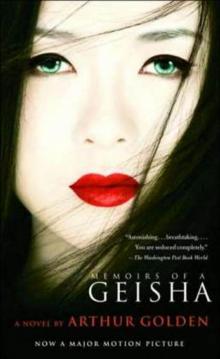
Memoirs of a Geisha
Arthur Golden
Co-ordinate to Arthur Gilded'southward absorbing first novel, the word "geisha" does not hateful "prostitute," every bit Westerners ignorantly assume-information technology means "artisan" or "creative person." To capture the geisha feel in the art of fiction, Aureate trained as long and hard as any geisha who must master the arts of music, dance, clever chat, crafty battle with rival beauties, and cunning seduction of wealthy patrons. After earning degrees in Japanese fine art and history from Harvard and Columbia-and an M.A. in English-he met a man in Tokyo who was the illegitimate offspring of a renowned businessman and a geisha. This meeting inspired Golden to spend 10 years researching every item of geisha culture, chiefly relying on the geisha Mineko Iwasaki, who spent years charming the very rich and famous.
Arthur Golden
Memoirs of a Geisha
For my wife, Trudy,
and my children, Hays and Tess
TRANSLATOR'S Annotation
1 evening in the spring of 1936, when I was a boy of xiv, my male parent took me to a trip the light fantastic toe performance in Kyoto. I remember only two things virtually it. The showtime is that he and I were the simply Westerners in the audience; we had come from our domicile in the netherlands only a few weeks before, so I had non yet adjusted to the cultural isolation and yet felt information technology acutely. The second is how pleased I was, after months of intensive study of the Japanese linguistic communication, to discover that I could now sympathize fragments of the conversations I overheard. As for the young Japanese women dancing on the stage before me, I call back nothing of them except a vague impression of brightly colored kimono. I certainly had no way of knowing that in a time and identify as far away every bit New York City nearly fifty years in the hereafter, ane among them would get my skillful friend and would dictate her extraordinary memoirs to me.
As a historian, I have e'er regarded memoirs as source textile. A memoir provides a record non so much of the memoirist as of the memoirist's earth. It must differ from biography in that a memoirist can never attain the perspective that a biographer possesses as a matter of course. Autobiography, if at that place really is such a thing, is like asking a rabbit to tell us what he looks like hopping through the grasses of the field. How would he know? If we want to hear near the field, on the other hand, no one is in a amend circumstance to tell us-and then long as nosotros keep in heed that we are missing all those things the rabbit was in no position to observe.
I say this with the certainty of an academician who has based a career on such distinctions. And yet I must confess that the memoirs of my honey friend Nitta Sayuri accept impelled me to rethink my views. Aye, she does elucidate for us the very hole-and-corner world in which she lived-the rabbit's view of the field, if you lot will. There may well exist no improve record of the strange life of a geisha than the one Sayuri offers. Merely she leaves behind also a record of herself that is far more complete, more accurate, and more compelling than the lengthy chapter examining her life in the book Glittering Jewels of Japan, or in the various magazine articles about her that have appeared over the years. It seems that at least in the instance of this one unusual subject, no one knew the memoirist as well as the memoirist herself.
That Sayuri should have risen to prominence was largely a affair of chance. Other women take led similar lives. The renowned Kato Yuki-a geisha who captured the heart of George Morgan, nephew of J. Pierpont, and became his bride-in-exile during the starting time decade of this century-may accept lived a life even more unusual in some means than Sayuri'south. But merely Sayuri has documented her own saga and so completely. For a long while I believed that her selection to do and then was a fortuitous blow. If she had remained in Nippon, her life would take been too total for her to consider compiling her memoirs. However, in 1956 circumstances in her life led Sayuri to emigrate to the U.s.a.. For her remaining forty years, she was a resident of New York Metropolis'southward Waldorf Towers, where she created for herself an elegant Japanese-fashion suite on the thirty-2nd floor. Even so her life continued at its frenetic pace. Her suite saw more than than its share of Japanese artists, intellectuals, business organization figures-even chiffonier ministers and a gangster or two. I did not run across her until an acquaintance introduced u.s. in 1985. As a scholar of Nippon, I had encountered Sayuri'due south proper name, though I knew almost null near her. Our friendship grew, and she confided in me more and more. One day I asked if she would ever allow her story to be told.
"Well, Jakob-san, I might, if it's you who records it," she told me.
So information technology was that we began our task. Sayuri was clear that she wanted to dictate her memoirs rather than write them herself, because, as she explained, she was so accustomed to talking contiguous that she would hardly know how to proceed with no 1 in the room to listen. I agreed, and the manuscript was dictated to me over the form of eighteen months. I was never more than enlightened of Sayuri's Kyoto dialect-in which geisha themselves are called geiko, and kimono are sometimes known as obebe- than when I began to wonder how I would render its nuances in translation. But from the very start I felt myself lost in her world. On all but a few occasions we met in the evening; considering of long addiction, this was the time when Sayuri's heed was most alive. Usually she preferred to work in her suite at the Waldorf Towers, merely from time to time nosotros met in a private room at a Japanese restaurant on Park Artery, where she was well known. Our sessions more often than not lasted 2 or three hours. Although nosotros tape-recorded each session, her secretary was nowadays to transcribe her dictation as well, which she did very faithfully. But Sayuri never spoke to the tape recorder or to the secretary; she spoke always to me. When she had doubts about where to proceed, I was the i who steered her. I regarded myself as the foundation upon which the enterprise was based and felt that her story would never have been told had I not gained her trust. Now I've come to run into that the truth may be otherwise. Sayuri chose me as her amanuensis, to be certain, but she may have been waiting all along for the correct candidate to present himself.
Which brings us to the cardinal question: Why did Sayuri desire her story told? Geisha may not have any formal vow of silence, but their existence is predicated on the singularly Japanese conviction that what goes on during the morning in the office and what goes on during the evening behind closed doors bear no relationship to ane some other, and must always remain compartmentalized and separate. Geisha simply exercise not talk for the record virtually their experiences. Like prostitutes, their lower-course counterparts, geisha are often in the unusual position of knowing whether this or that public figure actually does put his pants on i leg at a time like anybody else. Probably information technology is to their credit that these butterflies of the dark regard their roles as a kind of public trust, simply in any case, the geisha who violates that trust puts herself in an untenable position. Sayuri'southward circumstances in telling her story were unusual, in that no one in Japan had power over her any longer. Her ties with her native country had already been severed. This may tell us, at to the lowest degree in part, why she no longer felt constrained to silence, but information technology does not tell united states of america why she chose to talk. I was afraid to heighten the question with her; what if, in examining her own scruples on the subject, she should change her mind? Even when the manuscript was consummate, I felt reluctant to inquire. Merely afterwards she had received her advance from the publisher did I feel it rubber to query her: Why had she wanted to document her life?
"What else do I have to practice with my fourth dimension these days?" she replied.
As to whether or not her motives were really every bit simple as this, I get out the reader to make up one's mind.
Though she was eager to have her biography recorded, Sayuri did insist upon several conditions. She wanted the manuscript published but afterward her decease and the deaths of several men who had figured prominently in her life. Every bit it turned out, they all predeceased her. It was a great business organization of Sayuri's that no one be embarrassed by her revelations. Whenever possible I have left names unchanged, though Sayuri did hide the i
dentities of certain men even from me through the convention, rather common among geisha, of referring to customers by means of an epithet. When encountering characters such equally Mr. Snowshowers-whose moniker suggests itself because of his dandruff-the reader who believes Sayuri is but trying to charm may have misunderstood her existent intent.
When I asked Sayuri's permission to use a tape recorder, I intended information technology only as a safeguard confronting whatever possible errors of transcription on the role of her secretary. Since her death last year, notwithstanding, I take wondered if I had another motive as well-namely, to preserve her voice, which had a quality of expressiveness I accept rarely encountered. Customarily she spoke with a soft tone, as 1 might wait of a woman who has fabricated a career of entertaining men. But when she wished to bring a scene to life earlier me, her vocalism could make me think there were six or viii people in the room. Sometimes all the same, I play her tapes during the evenings in my study and find information technology very hard to believe she is no longer alive.
Jakob Haarhuis
Arnold Rusoff Professor of Japanese History
New York University
ACKNOWLEDGMENTS
Although the character of Sayuri and her story are completely invented, the historical facts of a geisha's day-to-day life in the 1930s and 1940s are non. In the grade of my extensive research I am indebted to one individual higher up all others. Mineko Iwasaki, 1 of Gion's top geisha in the 1960s and 1970s, opened her Kyoto dwelling house to me during May 1992, and corrected my every misconception about the life of a geisha-even though everyone I knew who had lived in Kyoto, or who lived there all the same, told me never to expect such candor. While brushing up my Japanese on the airplane, I worried that Mineko, whom I had not yet met, might talk with me for an hour near the conditions and call it an interview. Instead she took me on an insider's bout of Gion, and together with her husband, Jin, and her sisters, Yaetchiyo and the belatedly Kuniko, patiently answered all my questions about the ritual of a geisha's life in intimate detail. She became, and remains, a good friend. I have the fondest memories of her family'due south trip to visit united states of america in Boston, and the otherworldly sense my married woman and I felt while watching tennis on tv in our living room with our new friend, a Japanese woman in her forties who too happened to exist one of the last geisha trained in the former tradition.
To Mineko, thank you lot for everything.
I was introduced to Mineko by Mrs. Reiko Nagura, a longtime friend and a fiercely intelligent adult female of my mother'southward generation, who speaks Japanese, English, and German with equal fluency. She won a prize for a brusk story she wrote in English language while an undergraduate at Barnard, just a few years after first coming to the United States to study, and soon became a lifelong friend of my grandmother's. The amore between her family and mine is now in its fourth generation. Her home has been a regular oasis on my visits to Tokyo; I owe her a greater debt than I can express. Along with every other kindness she has done for me, she read over my manuscript at various stages and offered a great many invaluable suggestions.
During the years I have worked on this novel, my married woman, Trudy, has provided more than help and back up than I had whatever right to wait. Beyond her endless patience, her willingness to drop everything and read when I needed her eye, and her frankness and extreme thoughtfulness, she has given me that greatest of gifts: constancy and understanding.
Robin Desser of Knopf is the kind of editor every writer dreams virtually: passionate, insightful, committed, e'er helpful-and a load of fun besides.
For her warmth, her directness, her professionalism, and her charm, in that location is no one quite like Leigh Feldman. I am extremely lucky to accept her for an agent.
Helen Bartlett, you know all you did to help me from early on. Thanks to you, and to Denise Stewart.
I'm very grateful to my skilful friend Sara Laschever, for her careful reading of the manuscript, her generous involvement, and her many thoughtful suggestions and ideas.
Teruko Craig was kind plenty to spend hours talking with me near her life as a schoolgirl in Kyoto during the state of war. I am grateful also to Liza Dalby, the only American woman e'er to get a geisha, and to her first-class book, Geisha, an anthropological study of geisha civilization, which also recounts her experiences in the Pontocho commune; she generously lent me a number of useful Japanese and English language books from her personal collection.
Thanks likewise to Kiharu Nakamura, who has written nigh her experiences as a geisha in the Shimbashi district of Tokyo, and kindly spent an evening talking with me during the form of my enquiry.
I am grateful, too, for the thoughtful insights and compassionate concern of my brother, Stephen.
Robert Singer, curator of Japanese art at the Los Angeles County Museum of Art, went to considerable problem while I was in Kyoto to show me firsthand how aristocrats there once lived.
Bowen Dees, whom I met on an plane, permitted me to read his unpublished manuscript about his experiences in Japan during the Allied Occupation.
I'm thankful also to Allan Palmer for giving me the benefit of his extensive cognition of tea ceremony and Japanese superstitions.
John Rosenfield taught me Japanese art history as no one else can, and made a university as gigantic every bit Harvard feel similar a small college. I'thousand grateful to him for helpful advice all along the way.
I'm profoundly in Barry Minsky's debt, for the valuable role he played as I worked to bring this novel into being.
In improver, for their kindnesses likewise numerous to recount, thanks to David Kuhn, Merry White, Kazumi Aoki, Yasu Ikuma, Megumi Nakatani, David Sand, Yoshio Imakita, Mameve Medwed, the late Celia Millward, Camilla Trinchieri, Barbara Shapiro, Steve Weisman, Yoshikata Tsukamoto, Carol Janeway of Knopf, Lynn Pleshette, Denise Rusoff, David Schwab, Alison Tolman, Lidia Yagoda, and Len Rosen.
chapter ane
Suppose that you and I were sitting in a quiet room overlooking a garden, chatting and sipping at our cups of light-green tea while we talked almost something that had happened a long while ago, and I said to you, "That afternoon when I met so-and-and so... was the very best afternoon of my life, and likewise the very worst afternoon." I look y'all might put downwardly your teacup and say, "Well, now, which was it? Was it the all-time or the worst? Because it tin't possibly have been both!" Ordinarily I'd have to laugh at myself and agree with you. But the truth is that the afternoon when I met Mr. Tanaka Ichiro actually was the best and the worst of my life. He seemed so fascinating to me, even the fish olfactory property on his hands was a kind of perfume. If I had never known him, I'm certain I would not accept become a geisha.
I wasn't born and raised to be a Kyoto geisha. I wasn't even born in Kyoto. I'm a fisherman's daughter from a trivial town called Yoroido on the Sea of Japan. In all my life I've never told more than a handful of people anything at all about Yoroido, or about the house in which I grew up, or near my mother and father, or my older sister-and certainly not well-nigh how I became a geisha, or what it was like to be one. Most people would much rather bear on with their fantasies that my mother and grandmother were geisha, and that I began my training in dance when I was weaned from the breast, and so on. As a matter of fact, one day many years ago I was pouring a loving cup of sake for a human being who happened to mention that he had been in Yoroido only the previous week. Well, I felt equally a bird must feel when it has flown beyond the ocean and comes upon a creature that knows its nest. I was so shocked I couldn't stop myself from maxim:
"Yoroido! Why, that's where I grew up!"
This poor man! His face went through the most remarkable series of changes. He tried his best to grin, though it didn't come out well because he couldn't get the wait of stupor off his face.
"Yoroido?" he said. "Yous tin't mean it."
I long agone developed a very adept smile, which I call my "Noh smile" considering it resembles a Noh mask whose features are frozen. Its advantage is that men tin interpret information technology all the same they want; you tin imagine how often I've relied on it. I decided I'd ameliorate use it simply then, and of course information technology worked. He allow out all his breath and tossed downwards the cup of sake I'd poured for him before giving an enormous express joy I'm sure was prompted mor
e by relief than anything else.
"The very idea!" he said, with another big laugh. "You lot, growing up in a dump like Yoroido. That'due south like making tea in a bucket!" And when he'd laughed once more, he said to me, "That'southward why yous're so much fun, Sayuri-san. Sometimes you most make me believe your footling jokes are real."
I don't much like thinking of myself equally a cup of tea made in a bucket, but I suppose in a way it must exist true. Later all, I did abound up in Yoroido, and no one would suggest it'southward a glamorous spot. Inappreciably anyone ever visits it. Every bit for the people who live there, they never have occasion to get out. You're probably wondering how I came to leave it myself. That'south where my story begins.
*
In our little fishing village of Yoroido, I lived in what I called a "tipsy firm." It stood well-nigh a cliff where the wind off the body of water was ever blowing. Every bit a child information technology seemed to me as if the ocean had caught a terrible cold, because it was always wheezing and there would be spells when it let out a huge sneeze-which is to say there was a burst of current of air with a tremendous spray. I decided our tiny firm must take been offended past the sea sneezing in its confront from time to time, and took to leaning dorsum because it wanted to go out of the fashion. Probably it would take collapsed if my begetter hadn't cut a timber from a wrecked fishing boat to prop up the eaves, which made the business firm look similar a tipsy old human leaning on his crutch.
Inside this tipsy firm I lived something of a lopsided life. Because from my earliest years I was very much similar my female parent, and hardly at all like my father or older sister. My female parent said it was because we were made just the aforementioned, she and I-and it was true we both had the same peculiar eyes of a sort you almost never run into in Japan. Instead of being dark chocolate-brown like everyone else's, my female parent's optics were a translucent gray, and mine are simply the same. When I was very young, I told my mother I idea someone had poked a hole in her eyes and all the ink had drained out, which she idea very funny. The fortune-tellers said her eyes were so pale because of too much h2o in her personality, so much that the other 4 elements were hardly present at all-and this, they explained, was why her features matched so poorly. People in the hamlet often said she ought to have been extremely bonny, because her parents had been. Well, a peach has a lovely taste and so does a mushroom, but yous can't put the ii together; this was the terrible play tricks nature had played on her. She had her mother's pouty mouth just her father'southward angular jaw, which gave the impression of a delicate motion-picture show with much too heavy a frame. And her lovely gray eyes were surrounded by thick lashes that must have been striking on her father, just in her case only made her look startled.
Source: https://onlinereadfreenovel.com/arthur-golden/31430-memoirs_of_a_geisha.html
0 Response to "Read Memoirs of a Geisha Free Online"
Post a Comment