Survival Tips How Many Do You Know?
These survival tips can aid you lot avoid becoming just some other statistic. Accidents are the leading cause of death among U.Due south. men 18 to l years quondam, accounting for 37,000 of the roughly 148,000 annual fatalities. Some instances of unintentional death, to use the official term, are unavoidable—wrong identify, wrong time—merely most aren't. Staying live requires recognizing danger, feeling fear, and reacting. "We interpret external cues through our subconscious fear centers very chop-chop," says Harvard University's David Ropeik, writer of How Risky Is It, Actually? Trouble is, even smart, sober, experienced men tin fail to annals signals of an imminent threat. Here we nowadays xx easy-to-miss risks, and how to avoid or survive them.
1. Outsmart Wildlife.
If you come up face up-to-confront with a wild animal, the natural response is to bolt, but that can trigger the animal's predatory instinct. On July 6, 2011, Brian Matayoshi, 57, and his wife, Marylyn, 58, were hiking in Yellowstone National Park when they came upon a grizzly bear and fled, screaming. Brian was bitten and clawed to decease; Marylyn, who had stopped and crouched behind a tree, was approached by the bear only left unharmed.
STAT: Each twelvemonth 3 to five people are killed in Northward America in wild brute attacks, primarily by sharks and bears.
DO: Avoid shark-infested waters, unless y'all are Andy Casagrande. As for bears, always bear repellent pepper spray when hiking; it tin can stop a charging bear from as much as xxx feet away. To reduce the risk of an attack, requite bears a chance to get out of your manner. "Endeavour to stay in the open," says Larry Aumiller, manager of Alaska's McNeil River State Game Sanctuary. "If yous have to move through thick castor, make dissonance by clapping and shouting."
2. Don't Mess with Vending Machines.
You skipped dejeuner. You demand a snack. You insert money into a vending automobile, printing the buttons, and null comes out. You get mad.
STAT: Vending machines caused 37 deaths betwixt 1978 and 1995, crushing customers who rocked and toppled the dispensers. No recent stats exist, but the machines are still a danger.
DON'T: Skip tiffin.
3. Stay on the Dock.
On May 20, 2013, Kyle McGonigle was on a dock on Kentucky's Crude River Lake. A dog swimming nearby yelped, and McGonigle, 36, saw that it was struggling to stay higher up water. He dove in to salve the dog, but both he and the animal drowned, victims of electrical-stupor drowning (ESD). Cords plugged into an outlet on the dock had slipped into the water and electrified it.
STAT: The number of almanac deaths from ESD in the U.S. are unknown, since they are counted among all drownings. Just anecdotal testify shows that ESD is widespread. ESD prevention groups have successfully urged some states to enact safety standards, including the installation of ground-error circuit interrupters and a central shutoff for a dock'south electrical system.
DON'T: Swim within 100 yards of any wired dock. But practise cheque whether docks follow safety standards.
4. Go on It on the Clay.
On the morning of July xiv, 2013, Taylor Fails, 20, turned left in his 2004 Yamaha Rhino ATV at a paved intersection near his Las Vegas–expanse domicile. The loftier-traction tire treads gripped the route and the vehicle flipped, ejecting Fails and a 22-year-quondam passenger. Fails died at the scene; the passenger sustained pocket-size injuries.
STAT: 1-third of fatal ATV accidents take identify on paved roads; more than 300 people died in on-road ATV wrecks in 2011.
Practise: Ride merely off-route. Paul Vitrano, executive vice president of the ATV Safety Institute, says, "Soft, knobby tires are designed for traction on uneven ground and will behave unpredictably on pavement." In some cases, tires will grip enough to cause an ATV to flip, equally in the recent Nevada incident. "If y'all must cross a paved road to continue on an approved trail, go straight across in get-go gear."
v. Mow on the Level.
Whirring blades are the obvious hazard. But most lawnmower-related deaths result from riding mowers flipping over on a slope and crushing the drivers.
STAT: Nigh 95 Americans are killed by riding mowers each yr.
DO: Mow up and down a slope, not sideways along it. How steep is too steep? "If yous can't support a slope, practise not mow on it," Carl Purvis of the U.S. Consumer Product Safety Commission advises.
half dozen. Beware Low-Head Dams.
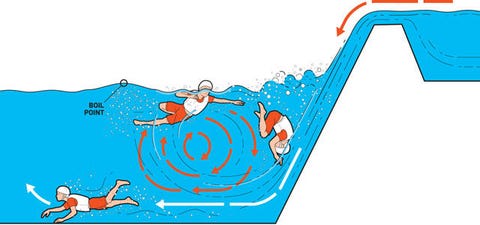
Institute on pocket-sized or moderate-size streams and rivers, low-head dams are used to regulate water catamenia or forbid invasive species from swimming upstream. Merely watch out. "They're called drowning machines considering they could not be designed better to drown people," says Kevin Colburn of American Whitewater, a nonprofit whitewater preservation group. To a boater heading downstream, the dams await like a unmarried line of flat cogitating water. But h2o rushing over the dam creates a spinning cylinder of water that tin trap a capsized boater.
STAT: Viii to 12 people a yr dice in low-head and other dam-related whitewater accidents.
DO: Whorl up, drop to the bottom, and motion downstream if defenseless in a hydraulic. "It'south a counterintuitive thing to do, simply the only outflow is at the bottom," Colburn says. Surface but afterward you've cleared the vortex near the dam.
7. Don't Hold your Breath.
If yous want to have a long swim underwater, the play tricks is to breathe in and out a few times and accept a big gulp of air before y'all submerge. Right? Expressionless wrong. Hyperventilating not only doesn't increase the oxygen in your claret, it as well decreases the amount of CO2, the compound that informs the encephalon of the need to breathe. Without that natural signal, you may hold your breath until you pass out and drown. This is known equally shallow-water coma.
STAT: Drowning is the fifth largest crusade of accidental decease in the U.S., claiming about x lives a solar day. No ane knows how many of these are due to shallow-water blackout, only its prevalence has led to the formation of advocacy groups, such every bit Shallow H2o Blackout Prevention.
DON'T: Hyperventilate before swimming underwater, and don't push yourself to stay submerged equally long every bit possible.
8. Proceed your Footing.
One mistake is responsible for almost half of all ladder accidents: conveying something while climbing.
STAT: More 700 people die annually in falls from ladders and scaffolding.
DO: Keep three points of contact while climbing; apply work-belt hooks, a rope and pulley, or other ways to get items aloft.
9. Ford Advisedly.
A shallow stream can pack a surprising amount of strength, making fording extremely dangerous. In one case y'all've been knocked off your feet, you can get dragged down by the weight of your gear, strike rocks in the water, or succumb to hypothermia.
STAT: H2o-related deaths outnumber all other fatalities in U.S. national parks; no specific statistics are available for accidents while fording streams.
DO: Cantankerous at a directly, wide section of water. Toss a stick into the current; if it moves faster than a walking pace, don't cross. Unhitch waist and sternum fasteners before crossing; a wet pack can pull you under.
10. Land Straight.
You have successfully negotiated gratuitous fall, deployed your awning, and are about to affect down. Prophylactic? Nope. Inexperienced solo jumpers trying to avoid an obstacle at the last minute, or experienced skydivers looking for a thrill, might sometimes pull a toggle and enter a depression-hook turn. "If y'all make that plough besides depression, your parachute doesn't have time to level out," says Nancy Koreen of the U.s. Parachute Association. Instead, with your weight far out from the canopy, you lot'll swing down like a wrecking ball.
STAT: Last yr in the U.S., low-hook turns caused five of the xix skydiving fatalities.
Practice: Scope out your landing spot well in advance (from 100 to 1000 feet up, depending on your skill) so you have room to land without needing to swerve.
11. Stay Warm and Dry.
Common cold is a deceptive menace—most fatal hypothermia cases occur when it isn't excessively cold, from 30 to 50 degrees Fahrenheit. Wet clothes compound the outcome of the temperature.
STAT: Hypothermia kills well-nigh 1000 people a twelvemonth in the U.S.
DO: Wear synthetic or wool wear, non moisture-trapping cotton. If stranded, conserve estrus by stuffing your apparel or shelter with dry leaves.
12. Let Leaning Copse Stand up.
The motorized blade isn't always the most dangerous thing near using a chain saw. Trees contain enormous amounts of energy that tin release in means both surprising and lethal. If a tree stands at an angle, it becomes meridian-heavy and transfers energy lower in the body. When sawed, it can shatter midcut and create a so-called hairdresser chair. The fibers divide vertically, and the rearward one-half pivots astern. "It's very trigger-happy and information technology'south very quick," says Mark Chisholm, primary executive of New Jersey Arborists.
STAT: In 2012, 32 people died felling trees.
DON'T: Saw into whatsoever tree or limb that's under tension.
13. Dodge Line Drives.
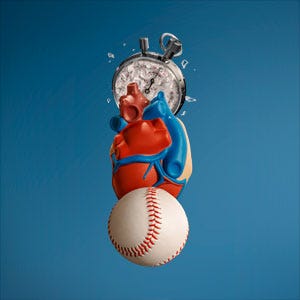
America'south national pastime may seem a gentle pursuit, but it is non without its fatal hazards. The 2008 volume Death at the Ballpark: A Comprehensive Study of Game-Related Fatalities, 1862–2007 catalogs deaths that accept occurred while people were playing, watching, or officiating at baseball games. Amid the causes is commotio cordis, a concussion of the heart that leads to ventrical fibrillation when the chest is struck during a critical ten- to 30-millisecond moment between heartbeats. Well-nigh 50 percentage of all victims are athletes (and the vast majority of these are male) engaging in sports that as well include ice hockey and lacrosse, the U.S. National Commotio Cordis Registry reports.
STAT: The registry recorded 224 fatal cases from 1996 to 2010. Commotio cordis is the No. 1 killer in U.S. youth baseball, causing two to three deaths a yr.
DON'T: Take a shot to the chest. Even evasive activeness and protective gear are not significant deterrents. Of notation: Survival rates rose to 35 percent between 2000 and 2010, up from 15 percent in the previous decade, due mainly to the increased presence of defibrillators at sporting events.
14. Climb with Care.
Accidental shootings are an obvious hazard of hunting, but guess what's just as bad: trees. "A tree stand hung 20 feet in the air should be treated like a loaded gun, considering it is every bit equally unsafe," says Marilyn Bentz, executive managing director of the National Bow hunter Educational Foundation. Nigh tree-stand up accidents occur while a hunter is climbing, she says.
STAT: Near 100 hunters a twelvemonth dice falling from trees in the U.S. and Canada, a number "equal to or exceeding firearm- related hunting deaths," Bentz says.
DO: Utilize a safety harness tethered to the tree when climbing, instead of relying on wooden boards nailed to the tree, which tin give way suddenly.
15. Avoid Cliffing Out.
Hikers out for a scramble may end upwardly on an uncomfortably steep patch and, finding it easier to climb up than downwardly, keep ascending until they "cliff out," unable to go either forwards or dorsum. Spending a nighttime freezing on a rock face waiting to be rescued is no fun, merely the alternative is worse.
STAT: Falls are one of the top 3 causes of death in the wilderness, forth with cardiac abort and drowning. Cliffed-out hikers account for xi per centum of all search-and-rescue calls in Yosemite National Park.
DON'T: Take a shortcut you can't run into the length of. If you realize you lot've lost your way, either backtrack or call for help. Gadgets such as DeLorme'due south inReach SE provide satellite communication to send a distress call from anywhere on the planet.
xvi. Don't Drink Too Much.
Nosotros all know that dehydration tin can be unsafe, leading to dizziness, seizures, and death, only drinking also much h2o can exist only equally bad. In 2002, 28-year-old runner Cynthia Lucero collapsed midway through the Boston Marathon. Rushed to a infirmary, she fell into a coma and died. In the backwash information technology emerged that she had boozer large amounts along the run. The excess liquid in her system induced a syndrome called exercise-associated hyponatremia (EAH), in which an imbalance in the body's sodium levels creates a dangerous swelling of the brain.
STAT: Up to i-3rd of endurance athletes who collapse during events suffer from EAH. Betwixt 1989 and 1996, when the U.S. Army mandated heavy fluid intake during exercise in loftier heat, EAH caused at least six deaths.
DON'T: Drinkable more 1.5 quarts per hour during sustained, intense practise. But practice consume enough of salt along with your fluids.
17. Utilize Generators Safely.
After Hurricane Sandy, many homeowners used portable generators to replace lost power, leaving the machines running overnight and allowing odorless carbon monoxide to waft inside. The gas induces dizziness, headaches, and nausea in people who are awake, but "when people go to sleep with a generator running, there's no chance for them to realize that something'south incorrect," says Brett Brenner, president of the Electrical Safety Foundation International.
STAT: Carbon monoxide from consumer products, including portable generators, kills most 200 a year. Of the Sandy-related deaths, 12 were due to carbon monoxide poisoning.
DO: Keep generators more than 20 feet from a business firm.
18. Don't Slip–Slide Away.
Hikers on a glacier or in areas where patches of snow remain above the tree line may be tempted to speed downhill past sliding, or glissading. Bad idea: A gentle glide can hands lead to an unstoppable plummet. In 2005 climber Patrick Wang, 27, died on California's Mount Whitney while glissading off the summit; he slid 300 feet before falling off a one thousand-foot cliff.
STAT: Ane or two people die each yr while glissading.
DON'T: Glissade, period. Simply if yous always practise it, you should be an expert mountaineer with well-expert self-abort techniques. Glissaders should always remove their crampons and know their line of descent.
19. Go with the Menstruation.
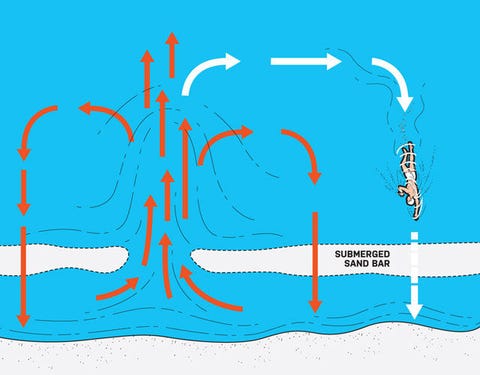
The tourist season got off to a grisly start this year in Gulf Shores, Ala. During a two-day period in early June, iv men drowned later on being defenseless in rip currents. The unusually potent currents were invisible, not even roiling the surface. Rip currents occur when water rushing back from the shoreline is channeled through a narrow gap between ii sand confined, accelerating the outward flow.
STAT: More than 100 Americans drown in rip currents each twelvemonth.
Practise: Allow the current to carry you out across the riptide's period, then swim laterally until y'all reach a position where you can turn and stroke safely to shore.
20. Beat the Heat.
A rock formation in Utah called The Wave is remote and beautiful, but besides arid and sweltering. This past July a couple hiking the surface area were found dead after the afternoon estrus overwhelmed them. Scarcely three weeks later, a 27-year-old woman complanate while hiking The Wave with her husband and died before he could get help.
STAT: An average of 675 people die each twelvemonth in the U.Southward. from oestrus-related complications.
Practice: Carry lots of fluids, hike in the morning, and let people know where you're going when trekking in the desert.
This content is created and maintained by a third political party, and imported onto this page to assist users provide their email addresses. Y'all may be able to find more information about this and like content at pianoforte.io
Source: https://www.popularmechanics.com/adventure/outdoors/tips/a3114/how-not-to-die-20-survival-tips-you-must-know-16030884/
0 Response to "Survival Tips How Many Do You Know?"
Post a Comment